
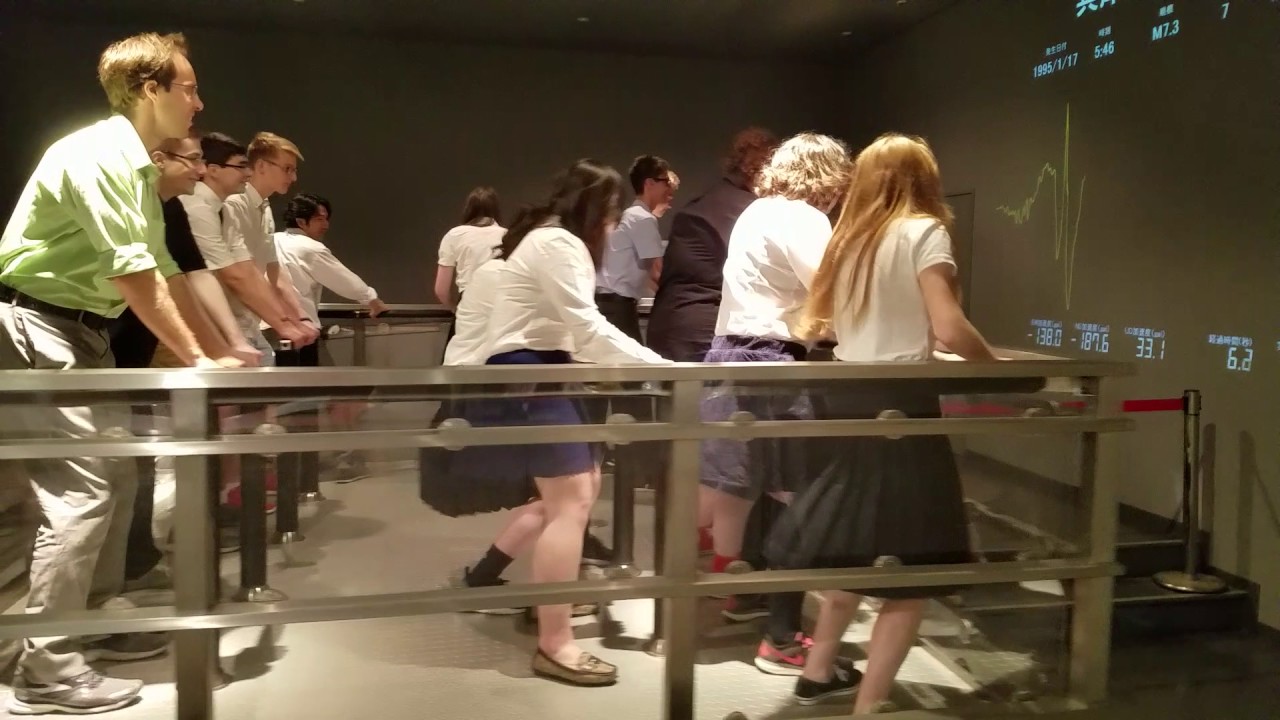
An instructor-led earthquake simulator session reproduces the 1995 Kobe earthquake and a predicted Hanshin scenario, emphasizing hands-on safety protocols and experiential disaster preparedness.
📊 Quick Facts
| Type | Interview |
| Author | Alexandre GAIN |
| Published | April 1, 2026 |
| Source | Visit Source |
| Location(s) | MURPHY's Law Boroughs |
🖼️ Illustrations
📝 Abstract
[Summary generated by AI] The author presents an instructor-led session on a mechanical earthquake simulator designed to convey the intensity and dynamics of major Japanese earthquakes. Resources include a motion platform equipped with central and side handrails, designated standing positions accommodating multiple participants, and a clear verbal safety protocol (continuous hand contact, feet shoulder-width apart, braced stance, prohibition on sitting, and a verbal Stop command to terminate the run). Methods involve sequential, timed runs: a 20-second reconstruction of the 1995 Hyogo-ken Nanbu (Kobe) earthquake (magnitude 7.3; maximum Shindo 7), followed by a longer, 60-second scenario earthquake projected for the Hanshin/Osaka region. The author frames the motions as representative of real strong-ground shaking, despite perceptions of exaggeration, and provides real-time guidance to maintain safe posture. Outcomes include realistic somatosensory exposure to extreme shaking, reinforcement of best-practice behavior during earthquakes, and a replicable instructional procedure for public education settings. Deliverables are a demonstrative protocol and participant experience that support disaster preparedness and risk communication objectives.